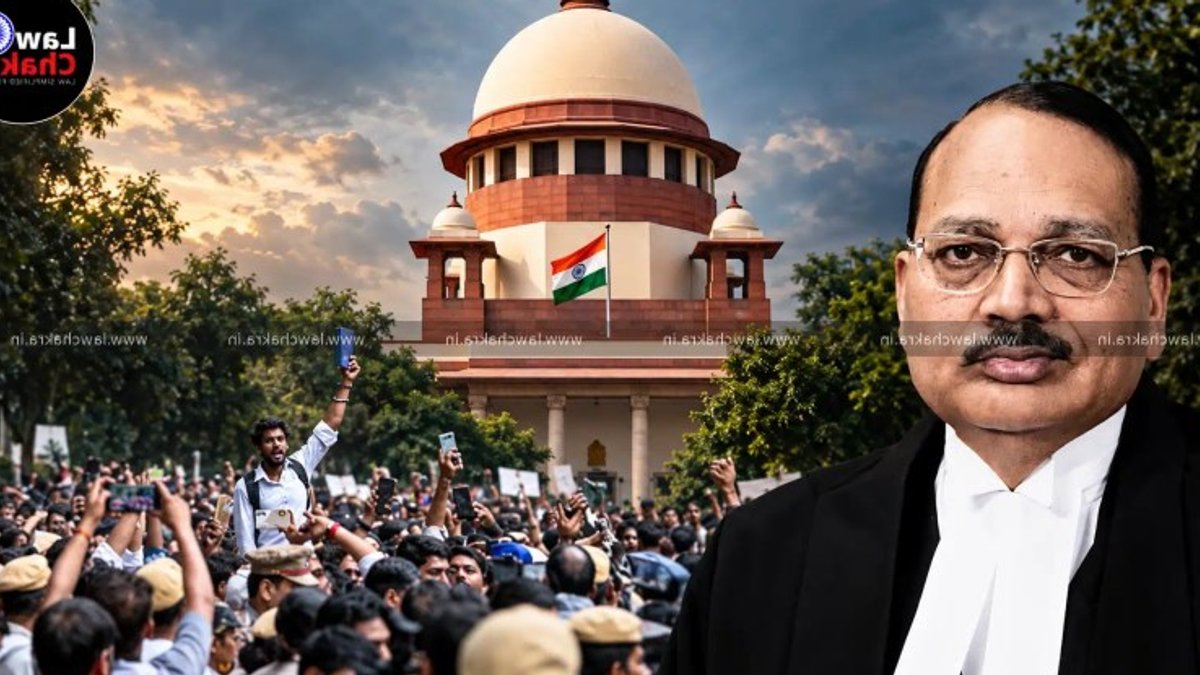
The Supreme Court sharply questioned a notice issued by an Executive Magistrate in Greater Noida to a university student in connection with the Cockroach Janata Party (CJP) student protests, with Chief Justice of India Surya Kant asking “how could a Magistrate dare to issue such a notice” when the Court had quashed the FIRs against the protesting students and expressly barred any coercive action against them.
A Bench of Chief Justice Surya Kant and Justices Joymalya Bagchi and V. Mohana was told of the notice through an oral mentioning, and indicated that it would seek an explanation from the authority concerned, asking the petitioner to place the notice on record through a proper petition. The matter was mentioned by Senior Advocate Bishwajit Bhattacharyya, who submitted that despite the Court’s recent order showing leniency towards the protesting students, a second-year student had been served a notice by the Executive Magistrate, Greater Noida, reportedly on the basis of Noida Police inputs.
Dated September 4, 2026, the notice followed a police report alleging that the student was “spreading and instigating anti-government misleading talks” among university students and encouraging them to join a proposed dharna by the CJP, and that his alleged activities had created tension with a possibility of a breach of peace. The Executive Magistrate, recording satisfaction with the police report, directed the student to show cause as to why he should not be required to execute a personal bond of ₹5 lakh, along with two sureties of ₹5 lakh each, to keep the peace.
The notice was issued under Sections 126 and 135 of the Bharatiya Nagarik Suraksha Sanhita (BNSS), with the show-cause order issued under Section 130. The Chief Justice reacted with evident disapproval, emphasising that the Court’s earlier order had left no room for any such step: “How could a Magistrate dare to issue such a notice? We had made it clear that no coercive action was to be taken against any student. No Magistrate could act contrary to that order.”
Related Post: CJP cancels march after court dismisses FIRs
Court calls student notice a contempt threat
Bhattacharyya framed the dispute as a direct challenge to judicial authority, arguing that the notice—even if later rescinded—represented a deliberate disregard for the court’s instructions. He urged that the students could not be made the subject of “an experiment,” and that the action prima facie amounted to contempt, submitting that “authorities cannot create a fear psychosis among students after this Court’s clear protection.”
Justice Bagchi asked whether there was any communication confirming the withdrawal and what cause of action remained if the notice was no longer operative. Bhattacharyya’s response framed the issue as one going beyond the individual student to the authority of the Court itself: “Contempt cannot be purged. It is contempt of the majesty of this Court. This is the highest court of the country.” The submission raises a point of some legal interest that the withdrawal of an offending action does not necessarily erase the contempt already committed, since the wrong lies in having defied the Court’s order in the first place, not merely in the continuing effect of the notice.
Legal battle over authority and withdrawal looms
The court has, at this stage, only sought an explanation rather than initiated contempt: the CJI directed that the notice be placed on record and that the District Magistrate be asked to account for it, leaving open both whether the notice in fact breached the Court’s order and whether, given its reported withdrawal, any contempt action will follow.
The episode nonetheless signals that the Court intends to police compliance with its protection actively, and that authorities acting against students over the CJP protests may be called upon to justify themselves before the Bench. The matter is expected to be taken up once the notice is formally placed on record.





Leave a Reply