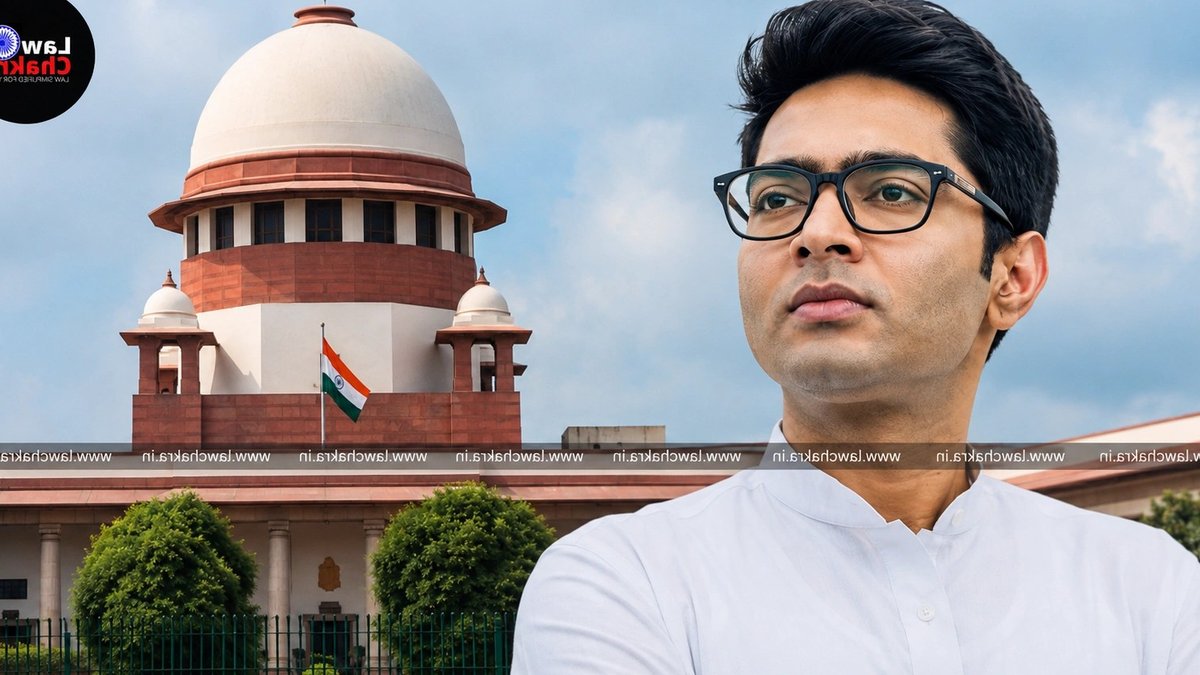
The Supreme Court delivered unusually blunt criticism toward central investigative agencies for their prolonged inaction in probing Leaps and Bounds, a company with direct ties to Trinamool Congress leader Abhishek Banerjee amid its entanglement in the West Bengal School Service Commission (SSC) recruitment scandal. Justice Joymalya Bagchi delivered the remarks during the hearing of Sumit Roy’s bail application in a separate land-scam case, declaring that “the less said about your agencies’ conduct, the better.” The Court’s sharp rebuke marked a rare instance where judicial scrutiny shifted entirely from the accused to the investigative agencies themselves, exposing systemic failures in the probe’s execution.
Agencies Ignore Court Orders Despite Repeated Warnings
The criticism centered on the agencies’ deliberate postponement of custodial interrogations in the Leaps and Bounds investigation despite repeated judicial warnings. The Solicitor General, Tushar Mehta, acknowledged during the hearing that approximately ₹30 crore had been transferred from the Trinamool Congress party’s account to the company, which already faced charges in the SSC scam. However, Justice Bagchi’s questioning revealed a stark disconnect between the severity of the allegations and the sluggish pace of the investigation. The judge specifically highlighted how the agencies had ignored multiple directives from the Calcutta High Court, which had previously expressed frustration over the stagnation of the probe. Mehta’s response—attributing the delays to “substantial influence from the accused”—further showed the agencies’ inability to operate independently, raising concerns about their institutional credibility.
Fragmented Probe Raises Questions About Coordination
The hearing also exposed the fragmented nature of the investigation, with multiple agencies handling overlapping aspects of the case. Mehta clarified that while the Central Bureau of Investigation (CBI) was leading the SSC scam probe, the Enforcement Directorate (ED) was simultaneously examining money-laundering allegations tied to Leaps and Bounds. Justice Bagchi pressed for specifics on how often the High Court had intervened to accelerate the process, demanding that the state provide a detailed account of judicial interventions. The Solicitor General assured the Court that all relevant documentation would be submitted, but the exchange laid bare the agencies’ failure to address repeated judicial concerns, suggesting a pattern of institutional inertia rather than isolated negligence.
Court Demands Transparency in Investigative Process
The Bench, comprising Chief Justice Surya Kant, Justice Bagchi, and Justice V. Mohana, responded by ordering the state to submit the interrogation materials immediately. Chief Justice Kant remarked, “We must examine that file,” while Mehta agreed to provide the recordings if they existed. The demand reflected the Court’s growing impatience with the lack of transparency in the investigative process. Unlike typical cases where judicial oversight focuses on protecting the accused from overreach, this instance highlighted the opposite problem: agencies failing to act decisively despite clear judicial directives.
The Leaps and Bounds investigation remains a critical component of the broader SSC scam probe, which led the Supreme Court to invalidate thousands of appointments in 2025. The company’s chargesheet and the ₹30 crore transfer from the Trinamool Congress’s account are central to the case, linking Abhishek Banerjee directly to the recruitment irregularities. Meanwhile, the Calcutta High Court is separately reviewing the freeze on the party’s accounts, including the disputed funds transferred to Leaps and Bounds. The overlapping inquiries—spanning corruption, money-laundering, and land fraud—have created a complex legal web, with investigative agencies, courts, and political figures entangled in prolonged litigation.
The hearing also revealed the broader implications of the Court’s intervention, as it coincided with other high-profile cases under judicial scrutiny. Earlier this year, the Supreme Court ordered a probe into the Indiabulls promoters over financial irregularities, and the recent election of Pradeep Rai as president of the Supreme Court Bar Association showed the judiciary’s expanding role in monitoring cases amid political and financial controversies. Unlike previous instances where the focus was on allegations against individuals, this hearing uniquely centered on the investigative agencies’ failure to adhere to judicial timelines, signaling a shift in how the Court assesses accountability in politically sensitive cases.
The proceedings have yet to result in a ruling on Roy’s bail or a final adjudication on the broader allegations. However, the Court’s insistence on reviewing the interrogation records marks a significant departure from conventional judicial oversight, where the emphasis is typically on protecting the accused rather than scrutinizing the investigators. The case now hinges on whether the agencies can demonstrate meaningful progress—or whether the Court will impose further deadlines to compel action. The exchange also raises broader questions about the independence of investigative agencies in politically charged cases, where external pressures may undermine their ability to conduct impartial probes.
Related: Supreme Court orders CBI probe into Indiabulls promoters
Related: Pradeep Rai elected Supreme Court Bar Association president





Leave a Reply