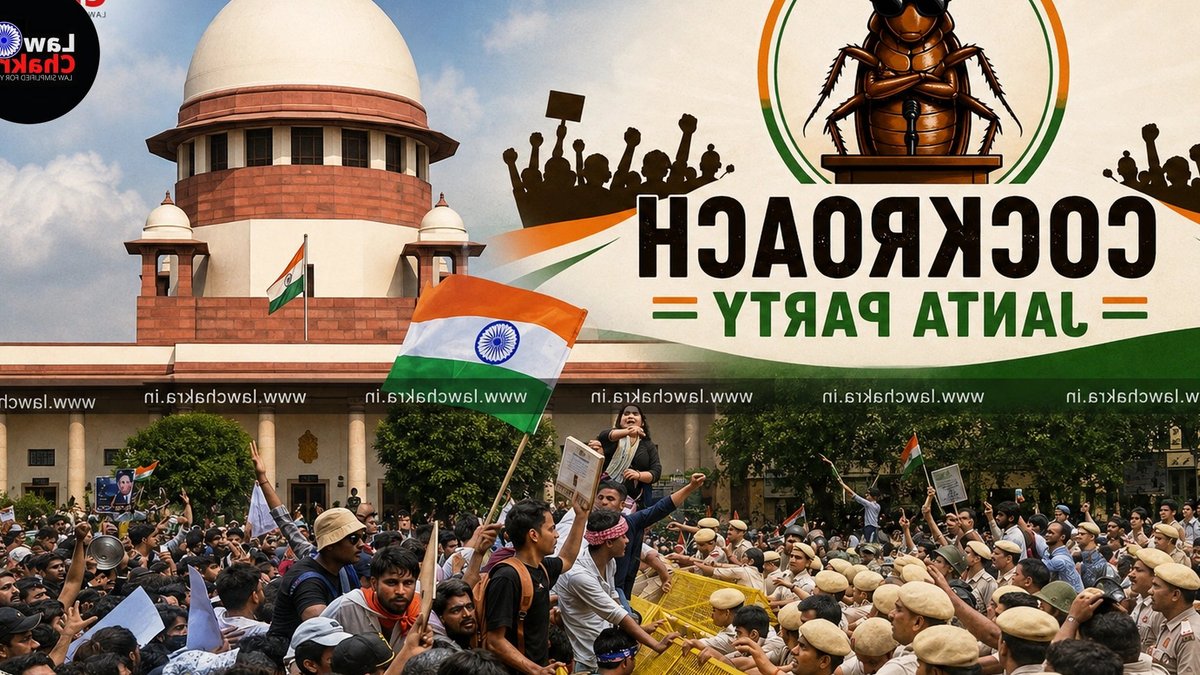
The Supreme Court declined to restrain the Cockroach Janata Party’s September 5 Delhi protest, saying it can’t presume anything untoward will happen and that law and order is for the police to handle.
A retired Delhi police officer, Rajendra Singh, had sought a direction that large-scale demonstrations or protest marches not be held in sensitive areas of the national capital without the requisite permissions.
Chief Justice of India Surya Kant and Justices Joymalya Bagchi and V. Mohana issued notice on the application to the Centre and the Delhi Police, but refused to list the matter before the date of the proposed march.
The application was moved by Rajendra Singh, who sought a direction that large-scale demonstrations or protest marches not be held in sensitive areas of the national capital without the requisite permissions.
Advocate Dr. Rizan Ahmed submitted that, to his knowledge, the organisers had not filed any application seeking permission for the September 5 march, and urged that it be postponed.
Ahmed placed particular emphasis on the timing, pointing to a major international summit due to be held in Delhi and the presence of the international media.
Related: Supreme Court orders CBI probe into Indiabulls promoters
The Chief Justice was unpersuaded that the Court should act pre-emptively to restrain a protest that had not yet taken place, or on the assumption that it would turn violent.
“We will at least, as of now, presume everybody will behave in a peaceful manner,” Chief Justice Surya Kant observed.
When Ahmed countered that “presumption comes out of experience,” invoking the violence that had accompanied the CJP’s July 20 march towards Parliament, the Chief Justice reiterated that the matter fell ultimately to be considered by the police authorities.
“Before us, there is no identified group,” Chief Justice Surya Kant told the applicant.
“You please impress upon Union or NCT Delhi,” he added, directing Ahmed to approach the relevant authorities.
Ahmed pressed his concerns further, submitting that the group was conducting itself as though the Bharatiya Nagarik Suraksha Sanhita did not apply to it, and that the nation might “pay a heavy price” if necessary action were not taken, given their past behavior.
The Court could not issue directions against a group that was not a party before it, Chief Justice Surya Kant responded.
Related: New Rules For Regulated Industries Released
“We are not calling upon anyone who is not party before us,” he said.
“Approach the central government,” he told Ahmed, advising him to take his concerns to the relevant authorities.
By declining to restrain the march while directing the applicant to the executive, the Court has kept a consistent line across the protest litigation, emphasizing the importance of the executive’s role in maintaining law and order.
The decision to tag the application with the main protest matters on September 10 also signals that the Court intends to deal with the interlinked issues through the single, structured mechanism it has already set in motion.
With notice issued and the matter listed for September 10, the immediate question of the September 5 march is left to be handled by the Delhi Police and the Central Government in the exercise of their law-and-order powers, as per the Court’s decision.
Nothing has been finally decided; the Court has neither permitted nor prohibited the march, but has declined to intervene in advance, leaving the regulation of the assembly to the executive and reserving the broader issues for its scheduled hearing.


Leave a Reply