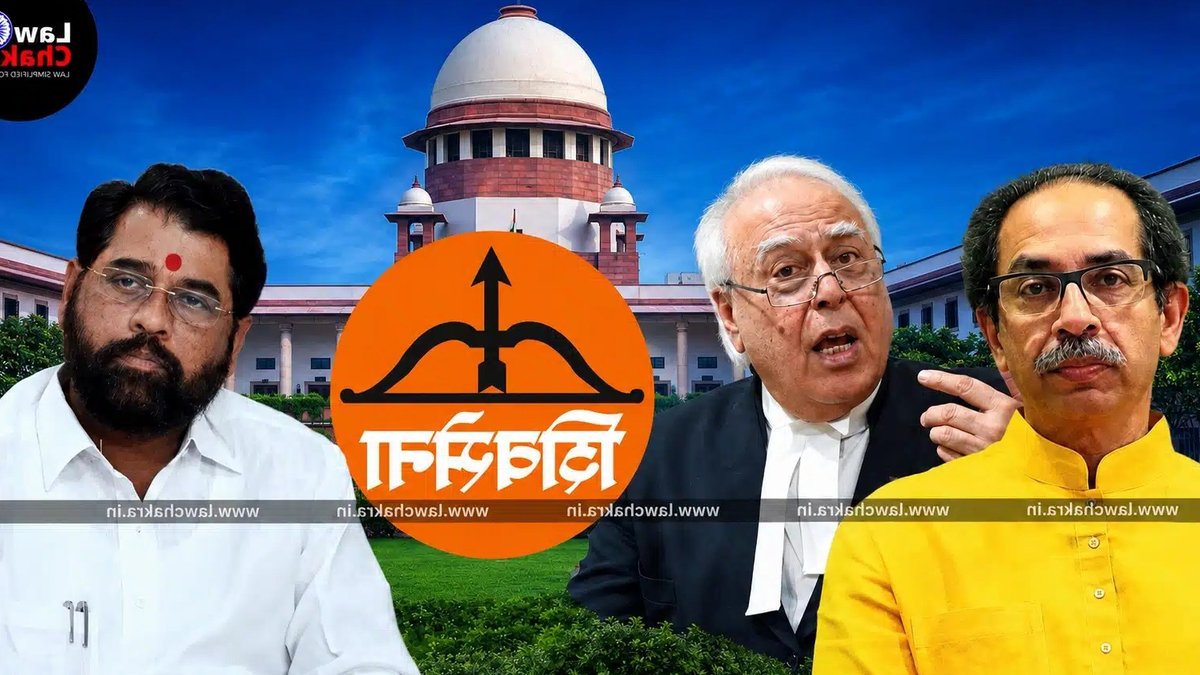
The Supreme Court heard arguments Wednesday in a dispute over the Shiv Sena’s internal split, asking whether it can itself disqualify legislators or only overturn the Speaker’s order. The case centers on the Eknath Shinde faction, which broke away from Uddhav Thackeray’s group in 2022, triggering a series of legal battles over party recognition, the “bow and arrow” symbol, and anti-defection laws.
Who can declare the MLAs disqualified?
Senior Advocate Kapil Sibal finished his arguments for the Thackeray faction, leading to a key exchange between the bench and Senior Advocate Devadatt Kamat. The central question for the court was whether it could act as the Speaker and disqualify the Shinde MLAs directly, or if it should simply quash the Speaker’s decision and send the matter back to him.
Justice Joymalya Bagchi pressed the limits of judicial review, asking if the court could assume the Speaker’s role. “Can we disqualify him today? Can we assume the role of the Speaker and declare Shinde disqualified?” Bagchi asked. Kamat argued that if the Speaker acted perversely, the court could grant consequential relief, but Bagchi drew a distinction. He said the court could quash a punishment but hesitated to impose its own punishment, noting the Speaker exercises quasi-judicial power. The justice compared the situation to a disciplinary proceeding, where a court might quash a penalty but remand the case for a fresh decision rather than deciding it itself.
Related: Miller Ruling: Sovereign Immunity Waived, State Law Claim Not
The question of timing and party leadership
Bagchi also focused on the timing of Shinde’s acquisition of the majority. He accepted that Shinde had the legislative numbers but questioned when he acquired them. “The primary question is: when he acquired that legislative majority, did he continue to remain the political party?” Bagchi asked.
Sibal countered that the Shinde group’s legitimacy was built on an “illegitimate act,” using the analogy of unauthorised construction on government land. He argued that passing time does not make the act lawful. Sibal also pointed to inconsistencies in the Shinde MLAs’ pleadings, noting that 39 MLAs had filed separate replies placing the 2018 party constitution before the Speaker, only to later claim that was a collective mistake by their lawyers. He urged the court not to interpret the Tenth Schedule in a way that permits defection, which he called a “constitutional sin.” The arguments concluded with a request that the Shiv Sena symbol be frozen for both factions if it could not be given to the Thackeray side.



Leave a Reply